Category: Update

  • Untitled post 1965

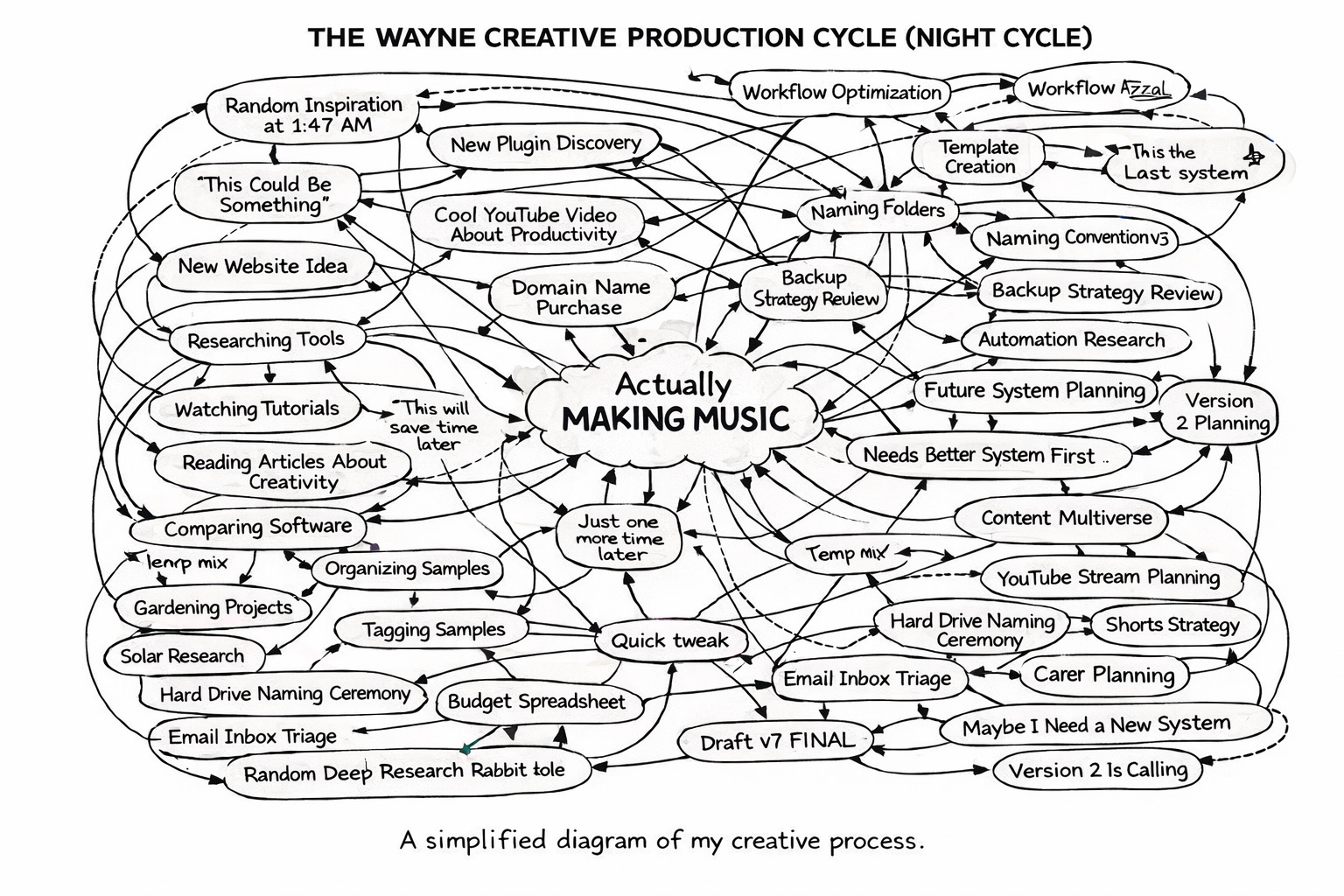
    my workflow Has a workflow

    I Am 97 Open Browser Tabs.

    I am the human version of 97 browser tabs open and one of them is playing music but I can’t find which one. Somewhere in the background, faintly, productivity is playing through a distorted speaker while I frantically click through dashboards trying to locate the source.

    My brain doesn’t have thoughts. It has project proposals.

    Every idea enters my head wearing a tiny blazer and carrying a pitch deck. It clears its throat and says, “This could be something.” It never says, “This could be fun.” It never says, “This could be small.” No. Everything is a potential ecosystem. A pipeline. A system. A workflow.

    I don’t relax. I context-switch.

    When most people unwind, they stop doing things. When I unwind, I simply change which thing I am doing. Rest is just productivity wearing sweatpants. If I’m not working on music, I’m working on content. If I’m not working on content, I’m working on tools. If I’m not working on tools, I’m researching tools to improve the tools I use for content about music.

    Somewhere in there, theoretically, is “life.”

    I don’t have imposter syndrome. I have CEO of Too Many Things Syndrome. I’m running a one-person corporation whose only employee keeps scheduling meetings with himself and never ships the product. Every morning there’s a standup meeting, and every evening there’s a postmortem, and in between there’s a Slack channel in my head that never stops pinging.

    I treat every idea like it’s the next startup. I can’t simply upload a stream replay. That would be too easy. Within minutes, I’m drafting a content distribution strategy, designing a thumbnail philosophy, planning a short-form clip funnel, outlining a long-term community roadmap, and considering a naming convention for future versions of the naming convention.

    I cannot just exist. Existing has no roadmap.

    I say I want balance, but my version of balance is juggling chainsaws while reading a productivity blog. I calibrate pink noise to cinema standards for content that people watch on their phones while eating cereal. I spend hours fine-tuning workflows for tasks that take minutes to perform. I build pyramids of preparation for huts of execution.

    I will research a task so hard the task expires.

    There is a special kind of procrastination reserved for people like me: productive procrastination. I do not avoid work by doing nothing. I avoid work by building the perfect environment in which work could theoretically happen someday under ideal lighting conditions.

    My workflow has a workflow.

    I crave automation because deep down I know the real bottleneck in my life is me generating more ideas. My to-do list has its own to-do list. Somewhere, inside a dashboard, a checkbox is waiting to be born. Somewhere, a template is waiting to be duplicated. Somewhere, a system is waiting to be optimized.

    I don’t need time management. I need idea birth control.

    I keep telling myself, “Once this system is done, everything will be smooth.” But the system is never done. It is a cathedral that keeps adding wings. Every hallway leads to another hallway. Every checklist spawns a sequel. Every solved problem reveals three new opportunities for improvement.

    My hobbies include making templates, making checklists, renaming folders, and starting sentences with, “Okay, let’s create a system for this.”

    I have turned productivity into a collectible card game, and I am desperately chasing the legendary workflow drop. Somewhere out there is the mythical setup where everything runs itself, where the machine hums quietly in the background while I finally relax.

    I keep trying to build a future where Future Me has it easy. The problem is that Future Me is drowning in dashboards created by Past Me.

    If I ever actually ran out of projects, I would panic and invent a new career by Thursday.

    And here is the uncomfortable truth: I secretly enjoy being busy because it makes me feel important. Slightly heroic. Like I am saving the world one spreadsheet at a time. There is something intoxicating about motion, about momentum, about the illusion that constant activity equals progress.

    Busyness becomes identity. Systems become comfort. Checklists become reassurance that everything is under control.

    But control is a mirage.

    The more systems I build, the more I realize the machine is not the destination. The machine is the hobby. The act of building the workflow becomes the reward. The optimization becomes the entertainment. The preparation becomes the craft.

    I keep trying to automate my life so I can finally relax. A self-sustaining creative reactor. A perpetual motion engine of productivity. A machine that runs without me.

    And yet, the moment a system is finished, I feel the itch to improve it. To tweak it. To version it. To rebuild it from scratch in a cleaner, more elegant form.

    Version 2 is always calling.

    Somewhere along the way, productivity stopped being a tool and became a personality trait. I do not simply do things. I architect the environment in which things might someday be done more efficiently.

    There is a quiet absurdity in all of this. A comedy hidden beneath the spreadsheets and dashboards. Because at the end of the day, the goal is not a perfect workflow. The goal is not a flawless system. The goal is not a beautifully organized folder structure.

    The goal is the work itself. The messy, imperfect, human act of making something and sharing it.

    And yet, I keep building the machine.

    Maybe the real lesson is not that systems are bad. Systems are helpful. Templates are useful. Automation is powerful. But they are scaffolding, not the building. They are tools, not the art. They are the stagehands, not the performance.

    The danger is mistaking preparation for creation.

    The danger is believing that peace lives in the next workflow tweak, the next optimization, the next version number. As if calm is a preset that just needs to be dialed in correctly.

    Maybe the most radical act is to do less optimizing and more doing. To allow imperfection. To allow unfinished edges. To allow the music to play even if one of the browser tabs is still making mysterious noise in the background.

    Because the machine will never be finished.

    And that is okay.

    I don’t need a vacation.

    I need a day where I am legally forbidden from optimizing anything.

  • At San Francisco State, when I would rehearse piano in those tiny, coffin-sized practice studios, the fire alarms would occasionally go off — tests, drills, whatever ritual sacrifice the building demanded that day. And they were loud. Obnoxious. NOIIIISY fuckers. The kind of alarm engineered to send a shockwave from your ears straight down to the base of your spine. Sonic warfare. Brutalist acoustics. A public service announcement written in pain.

    Normal people — aka not me — would hear it and think, get me the fuck away from this shit.

    Its peak lived around 3000 Hz, stacked with vicious subharmonics, blasting at roughly the highest legal level (about 110 dBA), powered by 24 volts of industrial rage — the kind of system meant for jet hangars, not college hallways. Our piano studios sat in the belly of the building, and the alarm itself hung from the ceiling dead center, like a mechanical god screaming into the void. I always found it deeply ironic that the music department chose a device so hostile to the human ear and installed it right at the heart of its practice chambers.

    If we were warned ahead of time that the alarm would be going off — meaning there was no real emergency — the students who actually gave a damn about their education hated leaving their rooms. Practice studios were first come, first serve. Step out, and someone was already waiting in the hallway, pretending to read while silently stalking your piano. Composition majors with a piano focus — aka me — didn’t get first dibs on the nicer rooms with grand pianos. Those belonged to the piano majors. Territorial laws of the academic jungle.

    And I had way too much music to learn and write to surrender my room to a vocalist warming up their scales because of a stupid fucking alarm. Absolutely not. Heck no, techno.

    Pictured here (Spring semester, 2011): An unusually clean practice space for me compared to some days. Sometimes we had to use the old electric keyboards because of the lack of available rooms in the weeks leading up to exams. Notice how I have nothing but the clefs written on the page but there’s only half the bottle of Macallan. Sometimes, it be like that though.

    So I stayed.

    I sat there while hell-on-earth tore through the building, annihilating any fragile hope of practicing for juries or coaxing notes onto staff paper. Instead, I plunked through chords, stubbornly pressing forward — and that’s when something strange happened. Something profound.

    As the alarm droned on, my perception began to shift. Panic softened. Adrenaline receded. And the noise — this merciless mechanical shriek — transformed into sound material. I started hearing pitch. Structure. Motion. I used the alarm’s fundamental as a drone, building harmonies around it, singing into it, syncing my playing to its internal pulse. What once felt like chaos slowly revealed an architecture.

    After prolonged exposure, the brain begins to sense rhythmic undulations hidden inside what seems like a flat, continuous tone. Crests. Troughs. Micro-cycles of amplitude rising and falling — temporal details normally filtered out by our neat, linear sense of time. Sympathetic harmonics emerged, stacking themselves into shifting rhythmic identities that grew bolder the longer the alarm screamed. Once the cortisone burned off and the sound refused to stop, time itself began to stretch. Everything slowed. The world widened.

    Another reason we need to feed more money into public education… music students’ habitual abuse of the department pianos.

    This is a long way of saying that shrill noise — those “harsh walls of sound” we encounter in places like jet runways, rooms full of crying babies, or roaring football stadiums — becomes something else entirely once we let go of resistance. Once annoyance dissolves, noise becomes music in a way harmony and rhythm alone can never achieve. It becomes immersive. Total. Existential.

    Of course, for your ears’ sake, you can’t marinate in that kind of intensity forever without consequences. You’ll go deaf eventually. But I think of it like hovering your hand over a flame, pulling it away just before the burn. It wakes you up. It reminds you that you’re alive.

    This act of melting into noise is something I’ve done instinctively my entire life. Loudness rarely repels me. Eventually, it reorganizes itself into usable sonic material in my mind. Sometimes it even pushes me into altered states — auditory hallucinations, light tripping, a strange mushroom-adjacent clarity. Sure, sudden sounds can still startle me. I’m human. But fundamentally, I believe anything can become music if you’re willing to override biology and surrender.

    The SFSU Chamber Singers were one of the best music groups I have ever been a part of. There’s nothing quite like the sensation of singing in a small choral ensemble, especially a very good one.

    I ended up composing part of a minimalist Catholic Mass — Kyrie, Agnus Dei, and Gloria — built directly from that alarm. The chamber singers performed it at the end of the semester. An enormous honor. Each movement was written in the alarm’s key, shaped by its harmonic debris and the reverberant character of the music department hallways, locked to the same hidden rhythm I’d discovered alone in that tiny studio. Me, an old battered piano, and that beautiful, brutal noise.

    This, musically, is how we make lemonade out of lemons.

    And that, my friends, is because:

    “Every single sound is interesting.” — John Cage

    I don’t have a video for my incomplete choral mass (yet), but here is a video of the SFSU Chamber Singers singing Stravinsky’s Mass which is far superior to mine. See if you can find me in a tux!

  • Callisto (also called Calypso) is my hard drive. And she dead, confirmed. This happened way too fast. This saga comes to an end.

    So… not great news. One of my moons died tonight.

    I name my drives after moons because each one holds some chunk of my creative universe. Io, Ganymede, Proteus, Mnemosyne… and Callisto, the big one. The archive moon. The heavy hitter.

    Callisto/Calypso, my once most trusted HD, is gone.

    Fully, completely, irreversibly fucked.

    Finder freezes on contact. Terminal chokes. ddrescue shows more red blocks than a communist parade. Estimated recovery time jumped to 532 hours and then the thing basically coughed blood and unmounted itself. That’s not corruption. That’s the read heads physically failing. The drive is just spinning its own obituary at this point.

    Ain’t nobody got time for that.

    And yeah, it took 2 TB of my life with it:

    • Tape Loops stuff from the very beginning until literally two weeks ago.
    • All my current film post-production WIPs — I get to rebuild those from zero.
    • Old writing, art, weird experiments.
    • A large percentage of 20 years of photos. Including pictures of friends and family who have passed away.
    • My entire digital music library, including the rare stuff I’ll never see again.

    It’s like someone hit “delete” on a section of my brain.

    I’m sitting here staring at the dead drive like it owes me money.

    I’ve spent all week pouring commands at it: rsync, diskutil, sector scans, flags on flags on flags.
    Every trick I know, every trick the internet knows, every trick AI knows. Even Disk Drill, the app that saved my last corrupted HD, was powerless against this issue.

    Nothing. The data is unreachable.

    Everything I tried… Just more errors, more bad sectors, more “operation not permitted,” the drive continuously unmounted itself or completely froze up… restart after restart after restart, leading to more and more existential dread. I’m being dramatic… I set my expectations for this possibility weeks ago, and like a loved one in hospice, I’ve already been saying my goodbyes, moving toward acceptance. 

    When ddrescue started skipping full chunks of the platter, I honestly laughed.
    One of those “Well this absolutely fucked” laughs. 

    The dumbest part? Some of the data is backed up somewhere. I just don’t know how much yet. Not the paid projects or Tape Loops though. I was just about to get to that, but I missed the window. 

    That’s a tomorrow problem. 

    Today is denial and carbs.

    I’m not really emotional about it. Not yet. Just numb.

    Like someone sanded the inside of my chest a little and said, “Alright, figure it out.”

    So yeah.

    If you’re reading this:
    – Back up your shit.
    – Back up the backups.
    – Don’t trust any drive, spinning or solid, with anything irreplaceable.
    – They don’t die gracefully. They don’t warn you. They don’t negotiate.

    Callisto is toast.

    A crater in the solar system of my memories.

    Io is my new external 8TB HDD, and it will be backed up regularly. Long live IoHD, I hope.

    And long live whatever I manage to salvage from the smoking wreckage.

    I’m going to bed.

  • Untitled post 1087

    Using the “Follow Action” function in Ableton Live Clip View while variating clip lengths and meters for each tone as a way to create controlled randomization in productions will generate interesting “temporal morphing” effects. Then I am mixing a layer of Mario Nieto’s Harmony Bloom MIDI-trigger VST, which is also controlled by variating MIDI instances (if/then algorithms), along with some subtle MAX4Live LFOs. The result is a “self-composing” piece that never sounds the same twice.

    Fig. 1 – Mario Nieto’s Harmony Bloom, the lava lamp of MIDI VSTs, in “spectator mode”. Read till the bottom of this post to see her in action!

    I’m having fun these days manipulating the “timescape” of geometric rhythms alternating from chaotic tone baths to somber & sobering polyphonies by carefully crafting variances in Ableton clips into a generative ambient/drone/soundscape/New Age (lolz) immersed with Mario Nieto’s Harmony Bloom (Fig. 1). And no, I’m not getting paid by him… yet. This takes a bit of meticulous MIDI mapping and testing, so I’ve made a couple live streams to show my process.

    The fundamentals of writing this melodic soup isn’t all about turning knobs, but more predicting the nature and results of how these clips will interact with eachother. I have to have some control over it, or it’s not mine, right? So I composed this octave-spanning, arhythmic, modal-based structure in a MIDI clip, then separated each note into its own moment, varying the lengths of the clips too.

    After a couple of rotations, the clips naturally start to intersect differently and sometimes go buck wild. This method of messing with time continuously surprises me with all the different ways to play this combination of notes. I then set up different clips (combined some to save time) and created variations of their instances.

    Fig. 2 – Now that’s a piano role. I kind just noodle it all into place, then tore it f*ck apart BWAHWAHA.

    Most importantly, each clip has the “follow action” in clip view activated and set to its own special settings, allowing it to do some really cool things. Usually it’s 60-75% “play again” and the rest “jump to [x]” or start back at zero. See below.

    I also incorporate silent/rest clips with differing time scales, at any given moment that section of notes will play go quiet in a track lane for a varying amount of time, then moving on to a one note sequence. (See fig. 3) All have different velocities randomized by Ableton’s MIDI tools, but I plan on modulating with the sacred geometry plug in I have. I’m pretty much going to have modulators modulate modulators anywhere possible so that any decision or change will affect several other things.

    Fig.3 – The clip numbers align with the number of the note (ex: G3 or Bb4), which I numbered starting with one at the bottom note and going up. So 1 = G1 and 23 is D6. The N-x equations naming the white boxes marks the time added or subtracted to the original 4 measure loop. So N+7 means “4 measures of silence plus seven extra eighth notes”, or 6.3 mm.

    This piece can be looped over and over and never sound the same as any other time it was played, allowing this little monster to kind of run on its own. I’m getting to auto-triggering transition material next, but first I want to master this form of controlled chaos and build the tools. So I’m making a bunch of racks that do my bidding and that I can incorporate into a larger project later. All of it is a lot of tedious work and making sure the signal trail isn’t broken in what is turning into a complex Rube Goldberg of a music piece. To be honest, I just want to see how hard I can push the CPU before it says stop.

    I’m definitely inspired by Brian Eno, Richard Devine, anyone else who likes to make a ripple on an instruments and watch the effects and modulators take on a life of their own. That’s similar to what I’m doing here.

    As far as vibe, I want this to be ambient, environmental, and soothing. But, the environment can be hostile at times, so I definitely don’t plan on it being your typical docile sleep music. I envision it oscillating somewhere between background and introspective tonality, and definitely with some weirdness in between. Erik Satie probably came up with this idea originally, and called it “furniture music,” aptly so. Music that blends into the background but you’ll notice when you need it and want to hear it.

    The musings of a mad scientist… Here’s a much more aesthetically pleasing stream I did last night which showcases HB a little bit more. Plus I gave her some purty colors! Enjoy.

  • Untitled post 903

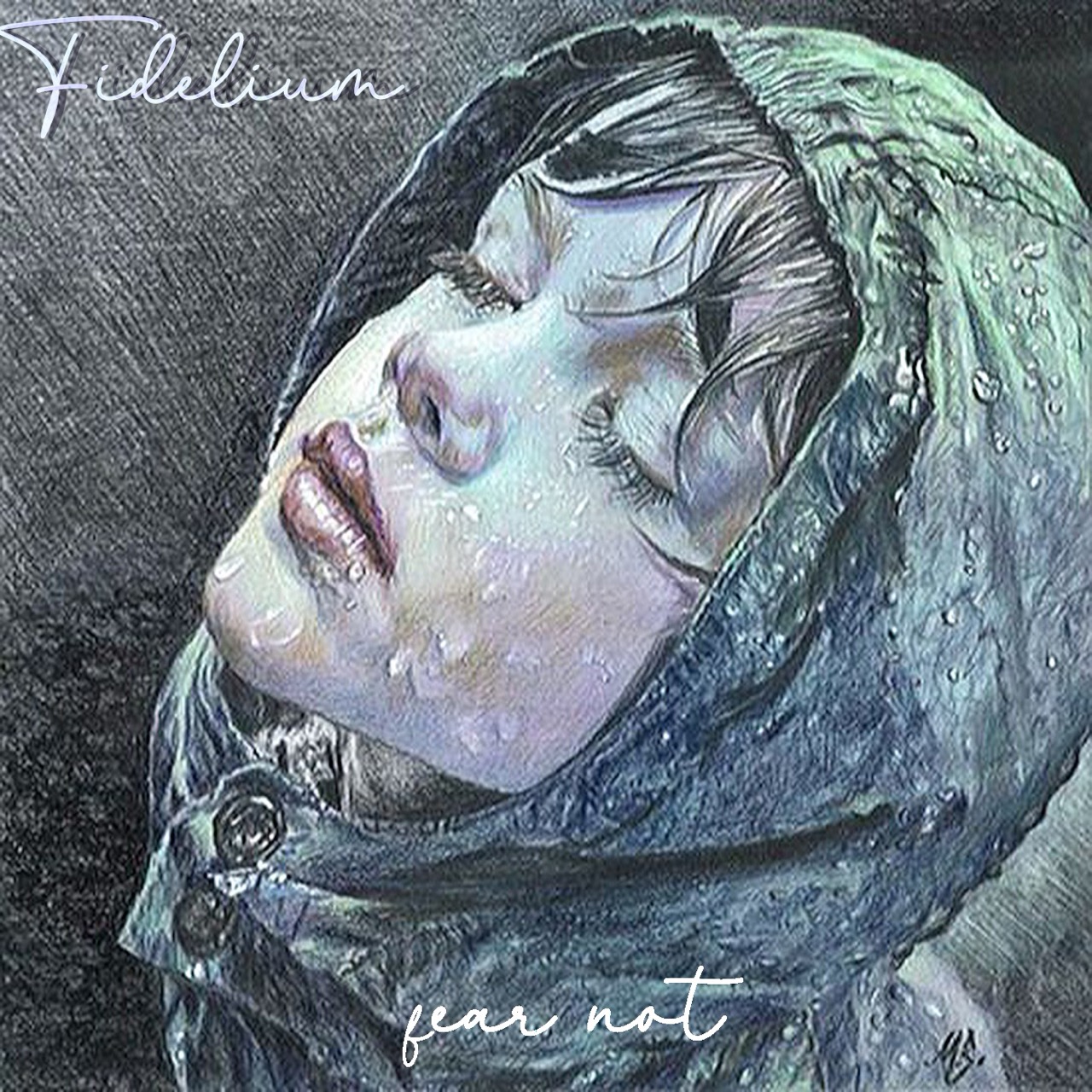
    FEAR NOT

    by fidelium

    Download on Bandcamp

    Like it? Share it:

    STREAM | DOWNLOAD

    Bandcamp
    Spotify
    Apple Music
    Soundcloud
    Amazon
    Deezer
    YouTube

    FEAR NOT

    (Released March 18, 2025)

    Well, I finally decided to put it out, as a single. There are more tracks from this project (titled “Everything Is Falling Apart”), and I’ll eventually meld them all together into one. Eventually. Let’s call it an “album in progress”.

    It’s nice to put out something under the Fidelium moniker again. Makes me all nostalgic. This whole series was written during one of the difficult periods in my life, around 2017. Was amidst a really shitty breakup, and was still living with them in a tiny apartment in the Tenderloin, San Francisco. My buddy Teddy came over and I recorded him playing some licks on his nylon string guitar. This simple major chord arpeggio he played so tenderly was stuck in my head for days after, and I felt inspired to transform it into what you hear now: “Fear Not”.

    The message is straightforward, to not be afraid when life has got you down, when you can barely get out of bed everyday, and you’re losing hope. I think I wrote this to give myself something uplifting for the spirit to work on (it kept me going), and now I give it away to the world. May it uplift you.

    Don’t give up hope.

    credits

    released March 18, 2025
    Written by Fidelium
    Guitar by Teddy Ronnie
    Mixed & Mastered by Fidelium
    Album art by Maria Zeldis (Kyiv,1955-2018)
    UPC: 198999891126
    Copyright 2025 Wayne Baker. All rights reserved.